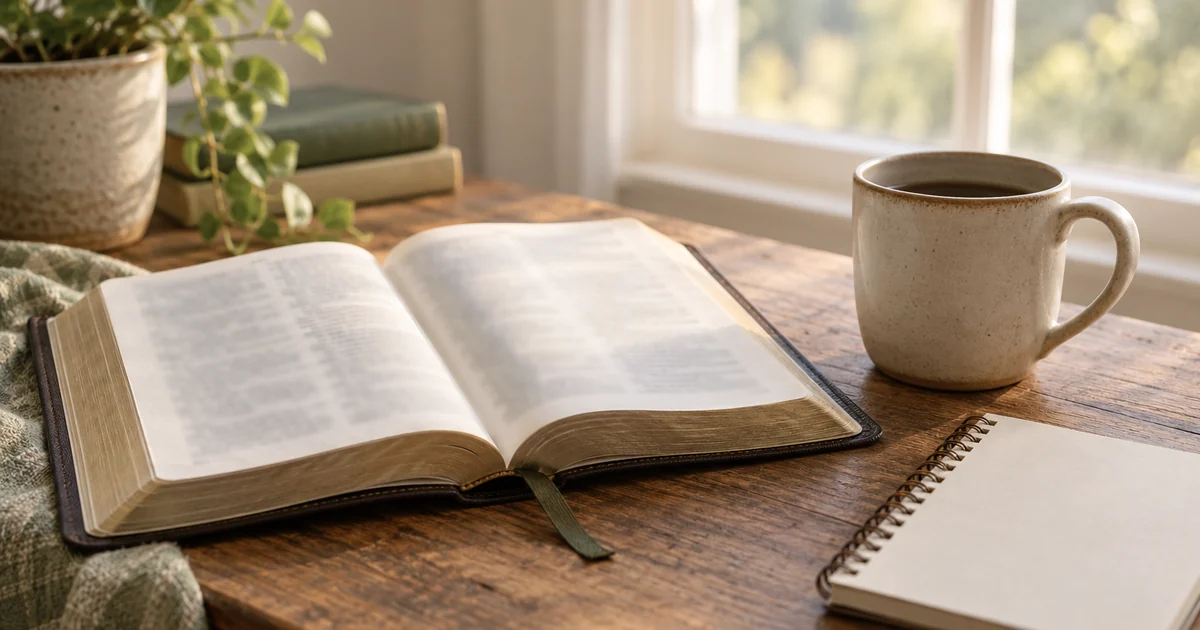
Starting to read the Bible can feel like a big project. It is a collection of many books, written in different times and styles, and you do not need to understand it all before you begin. Start with one short passage, a little context, and a routine you can return to.
If you are new, the Gospel of Mark is a straightforward place to begin. It moves through the life and teaching of Jesus in a clear narrative. You can also start with Luke, John, or a psalm. Choose a translation you can understand and, if possible, one that identifies its translation clearly.
1. Choose a small starting point
Pick a few paragraphs rather than trying to read many chapters at once. In Mark, you might begin with 1:16–20, where Jesus calls the first disciples. Read the passage once to follow what happens, then read it again more slowly.
A short passage gives you room to notice the words and the people in the scene. You can always read more later. Beginning with a manageable portion makes it easier to come back tomorrow.
2. Read the passage in context
Before asking what a passage means for you, notice what it says. Who is speaking? What happens just before and after? What does a repeated word or important detail contribute to the scene?
Use section headings as navigation, not as part of the original text. A study Bible or a trusted introduction can help with historical details, but you do not need a stack of reference books to start. When a sentence is confusing, keep reading the surrounding passage before drawing a conclusion from one line on its own.
3. Ask a few simple questions
You do not need a complicated study method. Ask what is happening in the passage, what you notice about God, Jesus, or the people there, whether there is a word or question you want to sit with, or whether there is something you want to ask, give thanks for, or remember today.
There may not be an immediate answer. It is fine to finish a reading with an open question. The aim is careful attention, not forcing a lesson out of every paragraph.
4. Keep the first routine small
Choose a time and place that already fit your day: a few minutes after breakfast, a quiet break, or before bed. Start with five to ten minutes. Read the passage, pause, and write down one observation if that helps you remember it.
Missing a day does not erase the days you did read. Simply return to the next passage when you are ready. A steady, modest routine is often easier to sustain than a demanding plan that leaves no room for ordinary life.
5. Try a simple plan
If choosing a passage each day feels like one decision too many, follow a short plan through a single book. A plan gives you a next step while keeping the text in sequence. Choose one that states what it covers and how long it takes, then adjust the pace to your schedule.
You can also read without a plan. Both approaches are useful: a plan adds structure, while open reading lets you stay with a question or book that interests you. If you want a simple place to begin, open today's free Scripture reading.
A one-week beginner rhythm
For your first week, keep the goal deliberately simple. Read one short section from Mark each day. On the first day, read Mark 1:1–8. On the second, continue with 1:9–20. Then read the next short section that follows, taking a break at a natural scene change rather than racing to finish a chapter.
After each reading, write one sentence about what happened or what you noticed. If you miss a day, pick up where you left off. At the end of the week, look back at your notes and choose whether you want to continue in Mark or try another book.
Common questions
### Which Bible book should a beginner read first?
Mark is a good starting place if you want a concise narrative about Jesus. Luke and John are also Gospels and offer different perspectives. Psalms can be a helpful place to read shorter poems and prayers. There is no single required order for beginning.
### How much of the Bible should I read each day?
Start with a short passage you can read attentively. A few paragraphs are enough. If a reading plan gives you more than you can manage, slow it down; the schedule is there to serve your reading.
### Do I need to understand everything I read?
No. Some passages take time, and Christians may interpret particular texts differently. Notice what is clear, use context, consult trusted sources when needed, and leave room for further learning.
### Is it okay to use a Bible app?
Yes. A printed Bible and a Bible app can both help you read. Choose whichever makes it easiest for you to return to the text. FaithWise offers a free daily Scripture reading on the web, and its optional Premium features are separate from starting that reading.
A small beginning is enough: choose a short passage, read it in context, and return when you can. Start with a free Scripture reading today.