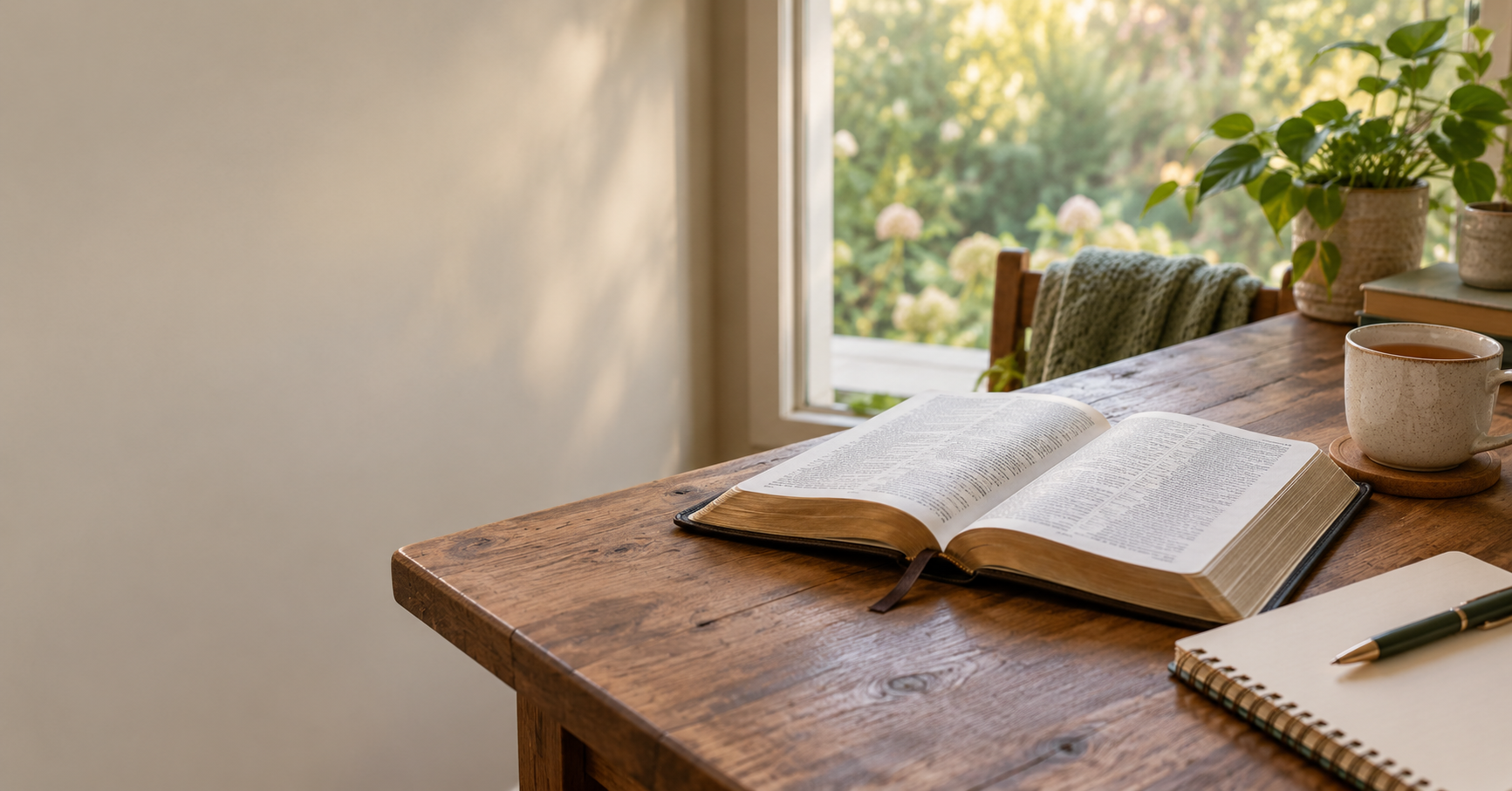
The Psalms give words for many seasons: gratitude, fear, grief, trust, anger, and praise. You do not have to make every prayer sound the same. A single Psalm can give you a place to begin when you have only a few quiet minutes.
This simple practice is not a formula for getting a particular feeling or answer. It is a way to read carefully, notice what is happening in the prayer, and speak honestly to God. The BibleProject guide to Psalms describes the collection as poetry shaped for reflection and prayer; you can take one small piece at a time.
A five-minute way to pray a Psalm
1. Arrive as you are
Take a breath and name what is true today: “I feel thankful,” “I am worried,” or “I don’t know what I feel.” You do not need to edit the answer before beginning.
2. Read the Psalm twice
Read a short Psalm once to hear its overall movement. Read it a second time more slowly. Notice who is speaking, what they are saying to God, and whether a word or image repeats. If a line is confusing, leave the question open and keep reading.
3. Notice the turn, if there is one
Some Psalms move from trouble toward trust or praise. Others stay with lament. Psalm 13, for example, holds an honest question alongside a decision to trust. Psalm 88 does not resolve its sorrow in the same way. You do not have to force a neat ending onto a prayer that does not have one.
4. Answer with your own words
Choose one phrase that stays with you. You can repeat it, ask a question, or turn it into a plain sentence of prayer: “God, I need help waiting,” or “Thank you for being with me here.” You are responding to the Psalm, not trying to improve it.
5. Sit quietly, then carry one phrase
Leave a short pause. If it helps, write down one phrase or keep it in mind as you move into the day. The goal is not to finish a certain number of chapters; it is to give your attention to the words in front of you.
Choose a Psalm for the season you are in
There is no perfect order. Start with the kind of prayer you need today:
- **For a familiar picture of care:** Psalm 23. - **For a direct prayer in trouble:** Psalm 13. - **For shelter and courage:** Psalm 27. - **For a heart that feels unsettled:** Psalm 42. - **For stillness in a shaken moment:** Psalm 46. - **For gratitude and praise:** Psalm 103. - **For waiting and hope:** Psalm 130.
These are starting points, not labels that limit a Psalm to one emotion. Read each passage in context and notice what it says for itself.
A gentle seven-day beginning
If choosing a passage each day becomes one more decision, try this week-long path. Read a Psalm a day, or spend two days with the same one if you want more time.
- **Day 1 — Psalm 23:** notice the images of guidance and care. - **Day 2 — Psalm 13:** bring an honest question into prayer. - **Day 3 — Psalm 27:** name what you hope for while you wait. - **Day 4 — Psalm 42:** notice the speaker’s longing and self-address. - **Day 5 — Psalm 46:** pause over the invitation to be still. - **Day 6 — Psalm 103:** notice what the prayer remembers and gives thanks for. - **Day 7 — Psalm 130:** sit with waiting, listening, and hope.
There is no catch-up day. If you miss one, continue with the next Psalm when you return.
Questions to keep beside you
You only need one of these questions at a time:
- What is the speaker feeling or asking for? - What does the Psalm say about God? - Which word or image did I notice today? - Is there a sentence here I can make my own? - What question do I want to keep open?
If the Psalm includes a promise, read it in its setting rather than treating it as a guarantee that a difficult situation will change immediately. The Psalms teach a wide language of prayer, including trust and unresolved sorrow.
A short prayer before you begin
God, meet me in the words of this Psalm. Help me notice what is here without pretending or rushing. Give me one honest response, and patience for the parts I do not yet understand. Amen.
When you are ready to make Scripture part of a small daily rhythm, start a free FaithWise reading. You can also read our realistic Bible plan for beginners or morning devotional routine. No payment is required to begin.
Sources and passages
- BibleProject: Book of Psalms guide - Psalm 13 · Psalm 23 · Psalm 27 · Psalm 42 - Psalm 46 · Psalm 88 · Psalm 103 · Psalm 130